

Fall Pressure Washing Checklist for Your Home's Exterior (Johnson County, KS)
If you're searching for "pressure washing before winter" or planning your fall exterior cleanup, there's one thing worth knowing before you book anyone: not every surface on your home should actually be pressure washed. Some should be - concrete, for instance, is built to take it. Others, like vinyl siding, wood decks, and fences, get cleaned safely with a different method: soft washing, which uses a cleaning solution instead of high-pressure water to do the work.
We'll get into that distinction below, because it matters for what "fall pressure washing" should actually mean for your home. But first, the timing: fall in Johnson County is short. Between the first cool mornings and the first hard freeze, homeowners have a narrow window to get exterior cleaning done before winter locks everything in place, including the algae, mildew, and staining that built up over a humid Kansas summer.
Most people think of fall home maintenance as gutters and furniture storage. That's only part of it. What happens to your siding, concrete, and trim in the next few weeks determines what your home looks like in April, and whether small problems this fall become expensive ones by spring.
Here's the checklist we use with our own clients, and the specific timing that makes it work in this market.
Fall Pressure Washing & Soft Wash Checklist for Johnson County Homes
- Clear and rinse gutters before leaf-drop is finished, check pitch and leaks
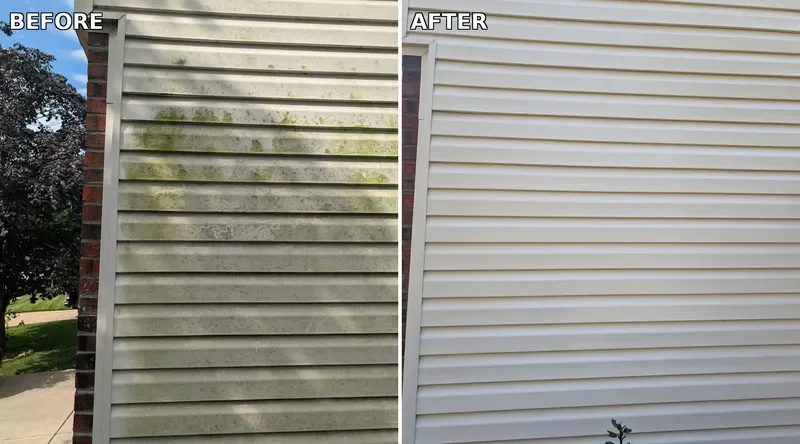
- Soft wash siding (not pressure wash it) before algae and mildew "set in" over winter
- Pressure wash concrete surfaces and seal cracks before freeze-thaw cycles start
- Inspect and address failing caulk and sealant around windows and trim
- Get exterior cleaning done before the average first freeze, mid-to-late October in Johnson County
1. Clear and Rinse Your Gutters
Falling leaves are the obvious fall gutter problem, but the real issue is what leaf debris does once it's wet and packed into a gutter channel for weeks: it holds moisture against the fascia and siding, and it's a major contributor to the black streaking (tiger striping) that shows up on gutter faces every year.
CurbSprout doesn't perform interior gutter cleanouts - that's a job for a gutter specialist, and we want to be upfront about that. What we do include with every house wash is a gutter face pass using the same surface-safe cleaning chemistry applied during the house wash. It won't address heavy oxidation or deep tiger striping, but it removes the surface-level mildew and grime that accumulates over summer and leaves gutter faces noticeably cleaner. If your gutters are already clear of debris, it's a solid complement to the house wash before winter sets in.

2. Pressure Washing Siding? Read This Before You Book Anyone.
Vinyl siding is one of the most common places we see pressure washing go wrong. High-pressure water can force its way behind seams and laps in vinyl siding, driving moisture into the wall cavity, the kind of damage that doesn't show up the day of service, but shows up as mold or rot months later. It's also common for direct high pressure to crack or blow off vinyl panels outright, especially at close range.
This is exactly why we soft wash siding instead of pressure washing it. Soft washing uses a low-pressure application and a professional-grade cleaning solution to do the actual work of breaking down algae, mildew, and grime. The water isn't what's cleaning the surface, the chemistry is. That means full effectiveness on siding, brick, and stucco without the risk that comes with forcing water where it doesn't belong.
Concrete is the opposite case. It's built to take direct pressure, which is why we do use high-pressure surface cleaning there. The method should always match the surface. Anyone offering to "pressure wash your whole house" as one blanket service, siding included, is using the wrong tool for at least part of that job.
This is also the step homeowners most often skip in fall, and it's the one with the biggest downside for skipping it.
The dark streaking you see on siding and roofing in this region isn't dirt or soot. It's typically a living organism, a cyanobacteria called Gloeocapsa magma, and it thrives in exactly the conditions Johnson County has all summer: sustained humidity above 60%. By early autumn, those colonies have had a full growing season to mature.
Left alone, that biological growth doesn't go dormant for winter. It gets sealed in. Building science research on fall maintenance timing is consistent on this point: biofilms not addressed before winter can continue growing beneath the surface through the cold months, contributing to premature coating failure and even rot by spring. That's the difference between a fall soft wash and a "we'll get to it in spring" plan: one prevents the problem, the other lets it compound over winter.
There's also a hard deadline on when this kind of cleaning can be done effectively at all. Cold weather works against the solution the same way it works against everything else outdoors this time of year. That's the same reason soft washing works differently than pressure washing in the first place; the cleaning solution is doing the work, not water force, so it needs the right conditions to actually work. In Olathe, the average first fall freeze is October 23. That's not a scare date, it's a scheduling fact. Once temperatures start regularly dropping toward that freeze threshold, your effective cleaning window is closing, and once it closes, you're waiting until spring while a full season of biological growth sits on your siding.
Manufacturer guidance backs up the cadence, not just the deadline: James Hardie's own technical bulletins recommend a cleaning cycle every 6 to 12 months to remove organic contaminants from fiber cement siding. If your last wash was this past spring, fall is exactly on schedule.
3. Clean and Seal Concrete Before Freeze-Thaw Cycles Start
Concrete takes a specific kind of damage in this region that most homeowners don't think about until it's already happened: freeze-thaw cracking. Water sitting in small surface cracks or pores expands when it freezes, and repeated freeze-thaw cycles over a Kansas winter widen small cracks into real ones. Getting concrete cleaned in fall does two things: it removes the organic buildup and staining that accumulated over summer, and it gives you a clear look at any cracks that need sealing before winter moisture has a chance to work on them.
This is also the point in the season where deck and patio surfaces, and fence sections, deserve the same look. A summer's worth of algae and grime on wood surfaces has the same "set in over winter" problem as siding, and decks and patios are exactly where Johnson County homeowners want things looking sharp for fall entertaining and holiday hosting before the weather turns.

4. Inspect Caulk and Sealant Around Windows and Trim
This one isn't a CurbSprout service, but it's worth doing at the same time as your exterior cleaning, because a fall wash is often the moment homeowners actually see this stuff clearly for the first time all year.
Failing or cracked caulking around windows and trim gives freezing rain and snowmelt a path behind your siding, exactly the kind of moisture intrusion that turns into a bigger repair by spring. If we notice deteriorated caulking, loose mortar, or similar conditions during a job, we'll document it and flag it to you directly. Repairs themselves are outside our scope, but knowing about a problem before winter is worth a lot more than finding out in March.
5. Know Your Deadline: The Freeze-Risk Window
If you take one date away from this article, make it this one: October 23, the average first fall freeze for Olathe. Kansas City proper runs a few days later due to the urban heat island effect, and areas further south like Paola see freeze risk arrive earlier, in mid-October.
That date matters because once hard freezes start, water left in siding laps, masonry pores, or unsealed cracks is what causes the kind of physical damage described above. Scheduling exterior cleaning with a buffer before that date, not the week of, when every soft washer in Johnson County is booked solid, is the difference between getting ahead of it and running out of runway.
THE BOTTOM LINE
Fall exterior cleaning in Johnson County isn't about making your home look nice for a few weeks before winter, although it does that too. It's about not letting a summer's worth of biological growth get sealed in by the first freeze, and not letting concrete and caulking issues sit through months of freeze-thaw cycles before anyone addresses them.
The window is real, and it's shorter than most people think. If your home hasn't been washed since spring, or you're not sure when it was last done, now's the time to get on the schedule. Still curious about what happens on the day of service, see how CurbSprout approaches each job.
Get your home ready for winter. CurbSprout provides same-day response on every estimate request, with 100% ground-based soft washing and a Quality Guarantee on every job. Registered in Kansas. $1M General Liability Insurance on every visit.