

Should You Pressure Wash a Wood Deck or Fence? What Johnson County Homeowners Need to Know First
You searched "pressure washing wood deck" or "how to clean a wood fence" because a summer of cookouts, sprinkler runs, and kids tracking through the yard has left it looking rougher than it did in May — that gray, weathered look, maybe some green algae in the shady corners, and you'd like it handled while the weather's still good enough to do it right.
Here's the thing worth knowing before you rent a pressure washer or hire the first name that pops up: wood is one of the easiest surfaces to damage with too much pressure, and once it's damaged, you can't undo it. This isn't a scare tactic. It's physics. Wood is a fibrous, porous material, and a pressure washer's job is to blast material off a surface using force. On concrete, that's fine: concrete doesn't have a grain to raise or fibers to blow apart. On wood, high pressure does the opposite of what you want.
“Should you pressure wash a wood deck or fence? Not at full pressure.
High-PSI pressure washing can drive water into wood grain, raise the grain fibers, strip old stain unevenly, and leave streaks or splintering that show up weeks later.
Professional wood cleaning uses low-pressure application with a professional-grade wood cleaning solution to lift algae, mildew, and gray weathering without damaging the surface.”
What Actually Happens When You Pressure Wash Wood Too Hard
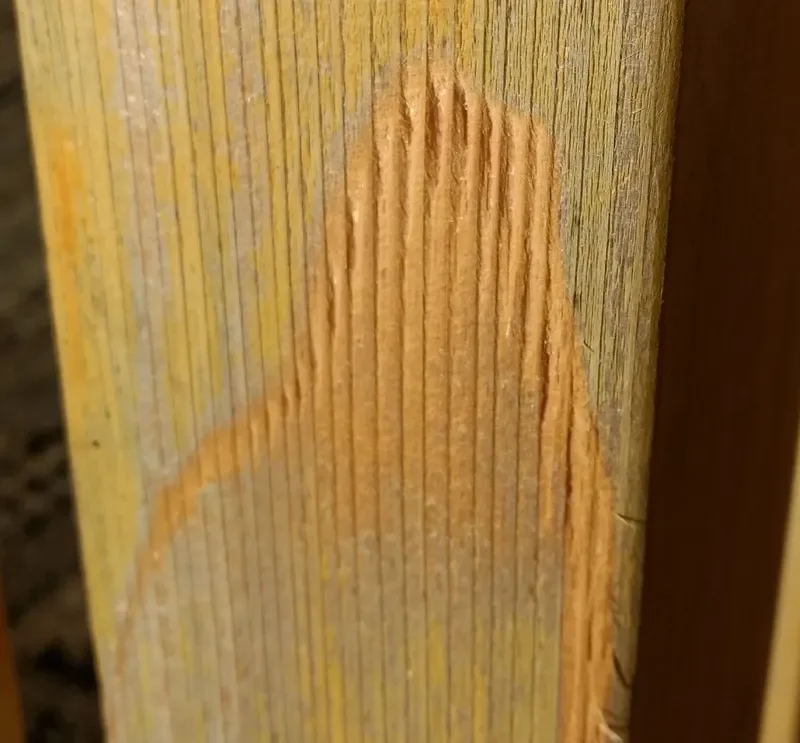
A consumer pressure washer running 2,000+ PSI concentrated on a narrow nozzle tip can do real damage to a deck board or fence picket in seconds. The most common outcomes we see when we're called in to fix a DIY pressure wash job or a previous contractor's low-quality work:
Raised or "fuzzed" grain. The pressure blows away the softer spring-growth wood fibers and leaves the harder fibers standing proud, giving the board a rough, hairy texture that never fully smooths back down
Splintering along board edges, especially on older, drier wood where the fibers have less flexibility
Uneven stain or finish removal. Pressure strips finish in blotchy patches rather than evenly, so what's left looks worse than what you started with
Water forced into the grain and seams. Wood absorbs the moisture, which can accelerate rot from the inside if the board doesn't fully dry before a new finish is applied
Etched or "striped" patterns, visible tracking where the operator moved the wand too slowly or held it too close
None of this is reversible with more cleaning. Once the grain is raised or the fibers are torn, sanding is often the only fix, and on some boards, sanding isn't enough. That's a full board replacement, which costs a lot more than the cleaning did.
The Difference Between High Pressure and the Right Method
The chemistry-versus-force distinction we cover in Soft Washing vs. Pressure Washing: What Johnson County Homeowners Need to Know applies directly to wood. Concrete is designed to take direct force. Wood is not. That's why professional wood cleaning flips the ratio: instead of using high pressure to blast contaminants off, we use a wood-safe cleaning solution to break down algae, mildew, and gray weathering at the surface level, then rinse it away at low pressure. The solution does the work. The water just carries it off.
This matters even more on wood than it does on vinyl siding, because wood doesn't just show pressure damage cosmetically. It shows it structurally. A gouged deck board is a safety issue, not just an eyesore.
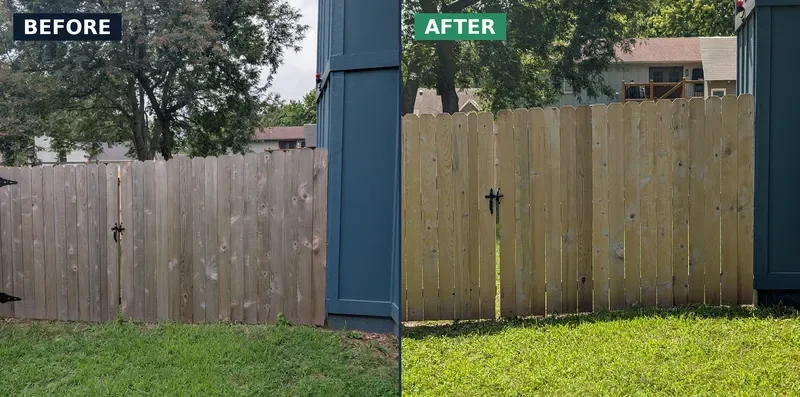
What We Actually Do: Our Process for Wood Decks and Fences
We treat every wood surface with the same care regardless of whether it's a deck, a fence, or a playset. Here's the general process:
Pre-soak. Before any solution touches the wood, we pre-soak the surface and any adjacent plants or landscaping with clean water. This protects nearby vegetation and gives us a clean baseline.
Apply a wood-safe cleaning solution. We use a professional-grade solution formulated for organic growth and gray weathering on wood, applied by hand sprayer and worked in with a soft-bristle brush, always with the grain, never against it, and never with a wire brush or anything abrasive.
Dwell time. The solution needs time to break down what's on the surface. We keep the wood moist during this window so the solution keeps working rather than drying out.
Low-pressure rinse. We rinse the solution and loosened debris away at low pressure, enough to clean, not enough to damage.
Brightening pass. For a final step, we apply a wood brightening treatment that helps neutralize the graying effect from UV and weather exposure, then rinse again.
Post-rinse everything nearby. All adjacent plants and landscaping get a final clean-water rinse.
We work by wood type, too. Pressure-treated pine and cedar are the two most common deck and fence materials in Johnson County, and both respond well to this process. Hardwood species like Ipe or Teak require different chemistry and are outside our current scope. If we find hardwood on a walkthrough, we'll tell you before any work begins rather than treat it the same way and risk a bad outcome.

What About Composite Decking?
If your deck is composite (Trex, TimberTech, Fiberon, or similar), the process is different, and the stakes are just as high. Composite is more forgiving of moderate pressure than natural wood, but it's not immune, and the wrong cleaning chemistry can cause its own problems. We use a professional degreaser and cleaning solution formulated for composite material, applied at low pressure, with targeted treatment for areas with heavier organic growth. If you're not sure whether your deck is natural wood or composite, that's a common question. We'll confirm it during the walkthrough.
Can You Rent a Pressure Washer and Do This Yourself?
You can, and plenty of homeowners do. If you go this route, a few things matter more than anything else:
Use the lowest effective pressure setting, and test in an inconspicuous corner first
Never use a zero-degree or narrow-angle nozzle tip on wood. A wide fan tip (25 to 40 degrees) spreads the force over a larger area
Keep the nozzle moving and keep it at least 12 inches from the surface
Always spray with the grain, never straight down into it
Skip the pressure washer entirely on any board that already shows soft spots, cracking, or old finish failure. That's a sign the wood can't take force-based cleaning at all
If any of that feels like more risk than you want to take on a deck your family walks on barefoot, that's exactly the calculation that leads most homeowners to call a pro instead. The math is simple: a bad DIY pressure wash job can cost you board replacement, which runs well past what professional cleaning would have cost in the first place.
When to Call a Professional
If your deck or fence has heavy algae, a previous stain or sealant that's failing, boards showing early signs of wear, or if you just don't want to be the one holding the wand over a surface that's expensive to get wrong, that's when professional soft washing makes sense. We assess the wood type, the condition, and the surrounding landscaping on-site, and we tell you honestly if a standard cleaning will get you where you want to be or if something more is needed.
Ready to get your deck or fence looking right without the risk? Get a free estimate and we'll walk you through exactly what your specific deck or fence needs.